

City of Munich Innovation Competition
The City of Munich is seeking innovative solutions and new concepts that have the potential to be tested and implemented in an urban test bed.
Who has the best solutions for the city?

Are you ready to contribute your ideas and collaborate with us to build the city of tomorrow?
The City of Munich’s Innovation Competition is an annual invitation to submit innovative proposals to tackle specific challenges the city is facing. The aim is to co-develop smart city approaches that will prove their value when put to the test.
The Innovation Competition is aimed at interested parties from among the startup community, students, innovation-driven entrepreneurs, and other creative minds eager to develop and realize viable, innovative solutions to the challenges presented.
The application deadline for 2026 has expired. The next innovation challenge will take place in 2027. New topics will be announced in spring 2027. Would you like to be notified as soon as the new call for applications is launched, either for the 2027 competition round or on an ongoing basis? Then please leave your contact details here.
Our challenges for 2026
How can we involve students in Munich in the creation and updating the city's geospatial data in an active and educational way, while at the same time strengthening their connection to their neighbourhood?
The GeodataService Munich manages the geospatial data that is available across the city, including the locations of trees and other objects in public spaces. Established surveying methods are used to capture and update these urban data sets.
We are looking for an innovative and mobile application for crowdsourced data collection with an educational value to improve verification and updates of the geospatial data. This tool should enable students to actively participate in mapping process during lessons and in their free time. In this way, data errors can be corrected and additional properties can be recorded. To improve the quality of the data, an AI integration could be implemented, for example, to identify the tree species.
However, the solution is not only aiming at improving existing urban geospatial data. It should also increase students’ understanding of the smart city approach, provide an educational benefit, and foster a sense of connection with their own neighbourhood. Thus, a virtual rewarding or ranking system could be another component of the submitted solution.
To ensure optimal integration into the city's geospatial data infrastructure, OGC-compliant data models and open, standardised exchange formats or data interfaces are preferred.
Contact persons for topic-related questions:
Department of Communal Services
GeodataService Munich
Korbinian Kringer
phone: +49 89 233 724151
digitaler.zwilling@muenchen.de
How can we make the city’s waste and rainwater disposal services visible and tangible for Munich citizens and other interested parties?
The Munich Wastewater Management (MSE) significantly contributes to the quality of life in Munich by ensuring secure drainage of sewage and rainwater. Yet the services mostly take place in the background and generally go unnoticed by citizens. To make the importance of this city infrastructure visible and tangible we are looking for innovative solutions using currently available technologies.
The goal is to create transparency and awareness and to inform citizens about what goes on underground and how their taxes are spent. A further goal is to contribute to educating and raising awareness, for example to explain what belongs in the wastewater pipes and what does not or the effects of different options of handling rainwater.
Innovative solutions could for example include:
- Use of immersive technologies such as Augmented Reality (AR) and Virtual Reality (VR)
- 360-degree views and virtual experiences that offer insights into underground structures.
- Mobile access e.g. via QR codes that allow users to access information on their smartphone or tablet.
- Virtual information boxes with links to video sequences and other content.
- Inclusion of third party media to explore the topic in more depth.
- Interactive digital platforms that provide information about the city’s infrastructure.
Other creative and innovative ideas are very welcome.
The solution should effectively supplement existing offers such as sewer canal tours or information campaigns, without any time constraints.
During the co-creation phase, the MSE invites candidates to implement and test their solution in a street section as a real-life test field, supported by the MSE.
A solution could also serve as blueprint for other underground infrastructures in the future.
Contact persons for topic-related questions:
Munich Wastewater Management (MSE)
Steffen Graf
phone: +49 89 233 61892
kommunikation.mse@muenchen.de
How can the Munich Wastewater company (MSE) read and gather the data of 9,000 scanned paper plans to increase the maturity level of the sewer network’s digital twin?
The scans contain important structural information such as the wall thickness of sewer pipes or diameter of a manhole. This data is crucial for our digital twin. Essentially the task is to read data from PDFs and transfer them into the GIS (geographical information system)
This use case is not only relevant for the Munich Wastewater company (MSE) but also for all technical municipal companies. In addition, there are many disposal companies worldwide that manage a similar data volume in PDF form. Numerous utility companies such as municipal utilities (electricity, water, gas) or international pipeline operators (gas, crude oil, chemicals) or electrical grids could benefit from this solution. The biggest benefit would be for companies that have, for historical reasons, installed very different network objects (manholes, valves, access structures).
For this use case the MSE will provide a comprehensive test bed allowing access to the GIS and the city’s AI, MUCGPT. If the application is successful we could also integrate the solution in other municipal companies.
The wastewater network is a critical infrastructure of the City of Munich and this should be taken into account when working with the data.
Our specific use case:
The MSE operates 37,000 manholes and 4,000 special structures allowing canal operators to safely access the underground pipe network of the City of Munich. Renovation, repairs and cleaning take place there. The most important key facts on the manholes are known: They are mostly found in the centre of roads. On busy roads they are located on the side to allow safe access. All sewer pipes are inspected by robots in fixed time intervals. The approximate coordinates and the manhole depths are recorded in the geo information system (NIS) of the MSE.
More detailed information is hidden away in 9,000 drawings that have now all been scanned. These drawings can be opened via a link in NIS.
The most important manholes were always built as the same standard manhole and exactly 16,057 times. There are also other manhole types that vary from common to rare. These are documented in 9,000 drawings.
You can see an example of such a drawing here.
Required information:
- Inner diameter of the manhole
- Wall strength of the manhole
- Other relevant characteristics such as material or existing special structures (e.g. valves, overflow thresholds, pumps)
This information would provide us with the following benefits, for example:
- More precise location of a building’s outgoing pipes.
- More precise measurement of a shaft’s backwater volume.
- Better use of underground space.
- More extensive analysis of canal data.
We look forward to your innovative ideas!
Contact persons for topic-related questions:
Munich Wastewater company (MSE)
Bernhard Agerer
Head of Canal Geoinformationssystem NIS
phone: +49 89 233 62336
mobile: +49 152 5794 6688
bernhard.agerer@muenchen.de
How can we use autonomous agents (Agentic AI) to tap into the scattered knowledge of the city administration so that case workers in the Department of Public Order and District Administration are able to make complex case decisions faster, more legally secure and independent of individual knowledge holders?
Public services in Germany are facing an enormous turning point: Approximately 25% of employees will enter retirement in the next 10 years. This risks an unprecedented loss of implicit specialist knowledge and procedural experience. Employees, especially new colleagues, are already spending disproportionate amounts of time looking for information in fragmented data structures (server networks, wikis, email chains, old reports).
The current “pain” in everyday work: A case worker often has to wait days or weeks for an answer to a specialised detailed question because the only person who “knows where it is” is too busy or not at work. This delays procedures for citizens such as gastronomy permits and endangers decision-making quality.
The aim:
We are looking for an AI solution that goes beyond the level of a simple chatbot. The aim is an autonomous agent that
- Actively connects: Independently combines information from documents, scans, wikis and specialised procedures.
- Understands context: Recognizes whether a report (e.g. 20 years old) is still based on current legal regulations.
- Prepares decisions: Delivers precise, source-based answers that can flow directly into processing a case.
The solution is to be initially developed for the area of commercial issues and consumer protection of the district inspection in the Department of Public Order and District Administration. For example, we imagine in this case that when looking for information regarding a restaurant licence, an AI-supported system would indicate that while a report it has found covers the issue being looked for, said report is already 20 years old and legal regulations have potentially changed. The AI could replace the memory of employees that are otherwise being constantly asked.
We are looking for creative approaches that meet the following criteria.
- Simple accessibility: The system must be easily and at all times accessible for all employees in the relevant specialised departments.
- Interactive user interface: A user-friendly interface that facilitates simple interaction with the system is crucial.
- Fast location of information: The system should offer an intuitive search function that enables employees to easily and quickly find the required data.
- Integration of an AI chat interface
- Continual updates: The system should be able to continuously update and filter information in order to ensure that the data is always up to date.
- Error-free and data protection-compliant data processing: All processes must be compliant with data protection laws and ensure high data integrity.
- Transparency: The source of the generated answers must be verifiable at all times.
- Integration in the city IT landscape: Integration into the city’s internal AI chat solution MucGPT is desirable but not strictly necessary (Open Source)
- Integration via the MCP protocol and the develop of an own assistant within MucGPT would be desirable.
- Documentation on MCP
- The IT department is currently in the process of acquiring an AI host for confidential data. This is to be used for processing confidential and personal data.
- Available models
We are looking for startups with basic experience in AI technology to work closely with employees of the district inspection and the AI Development & Services team in the IT Department during the co-creation phase. The project scope will be decided jointly and regular consultation and milestone dates are planned. The aim is to develop and evaluate a functioning prototype that is ideally scalable in all areas of the municipal administration which require specialist knowledge.
Tap into your innovation power and shape the future of the Munich City Administration!
Contact persons for topic-related questions:
Department of Public Order and District Administration
Trade and Industry, Consumer Protection
Lena Jocham
phone: +49 89 233 45789
lena.jocham@muenchen.de
District Inspections
Petra Weber
phone: +49 89 233 45757
p.weber@muenchen.de
How can the City of Munich use existing data from the ÖKOPROFIT programme to assist participating companies with AI-supported analyses and recommendations to assess and improve their environmental record?
The environmental consultation programme ÖKOPROFIT has been helping companies improve their environmental performance and reduce their carbon footprint since 1998. The programme offers, for example, workshops and on-site consultation for which various work materials are used. The existing Microsoft Excel-based work materials covering various environmental indicators and sustainability aspects have already been used across Germany by around 4,500 companies.
The City of Munich is now looking for innovative solutions to build on these ÖKOPROFIT work materials. We would like to develop an AI-based solution that makes it possible to efficiently analyse collected data and, based on this, offer participating companies a benchmark analysis and tailored recommendations to improve their environmental record. This means participating companies would be offered a real added value and ÖKOPROFIT would be designed in a futureproof way in order to increase the appeal of this city offer and secure a permanent demand.
We are looking for creative and innovation-driven startups or founders with experience in using AI for data analyses and have basic knowledge in the area of sustainability reporting. The solution must be user-friendly and ensure data protection in that it exclusively uses anonymised data.
As part of a co-creation project the companies of the current ÖKOPROFIT Club 2025/2026 should serve as a test bed for collecting initial data and testing the AI solution in practice. The goal is to achieve a significant improvement in data processing and use within the ÖKOPROFIT working materials that can also serve in the long-term as a model for other municipalities as part of the ÖKOPROFIT network in Germany.
Contact persons for topic-related questions:
Department of Labor and Economic Development
Sustainable Business & Mobility Team
nachhaltigkeit.raw@muenchen.de
Andrzej Michalski
phone: +49 89 233 520508
Christian Rothe
phone: +49 89 233 25516
The Innovation Award
The Innovation Award honors the most promising solutions with each winning team receiving 10,000 euros.
Aditionally the winners get the chance to work with the city government to further develop their submitted ideas and put them to the test. A further 15,000 euros are available as a grant for material costs during this co-creation phase. Detailed requirements can be found in the terms and conditions.
It’s worth taking part! All finalists selected to present their ideas to the jury are awarded 1,000 euros in honor of their participation as well as a free ticket for the Munich Startup Festival on July 22, 2026 at Backstage Munich.
Application deadline and process
The Innovation Challenge consists of two phases: the competition and the implementation phase.
The competition phase
- Application deadline: Sunday, May 17, 2026 at 11:59 p.m.
- Announcement of finalists: mid-June 2026
- Jury meeting with finalists’ pitches: Monday, July 6, 2026
- Awards ceremony: Wednesday, July 21, 2026 at the Munich Urban Colab
After the application deadline, the most convincing proposals will be selected. The finalists will be invited to present their proposals in person to an expert jury comprising of representatives from the participating city departments as well as various entrepreneurship centers. The jury will then select the most promising proposal for each challenge, which will receive the Innovation Award.
Applications can be submitted in German or English. However, the presentation to the jury has to be made in German since German is planned as the working language during the implementation phase.
The implementation phase
- Start of the co-creation phase: Fall 2026
- Duration: 3 to 6 months, to be agreed between the winning team and the respective department.
During the co-creation phase, solutions will be further developed and tested in a real urban context. When the implementation phase ends, the winners are warmly invited to present their results at a suitable urban event.
How do I benefit by participating?
- The winning teams receive the City of Munich's Innovation Award, worth 10,000 euros. The contest’s patron, Munich's Mayor Dominik Krause, will honor the winners at an official ceremony attended by the media.
- The winning proposals will also be further developed and tested in a real urban testbed. An addition 15,000 euros per challenge are available for this purpose.
- The award winners will gain access to the city government departments and to information and data to help them realize their ideas. They benefit from a network made up of city departments, startup support and entrepreneurship programs, as well as feedback and dialog with a diverse range of experts. Fresh insights and a rewarding learning experience are guaranteed!
- Coaching and support: Various entrepreneurship centers collaborate with the city government as part of the Innovation Competition. These cooperation partners can advise the award winners on their ideas and business model, as well as offering direct access to individual forms of support. If the winners are interested in one of the entrepreneurship programs, such as XPLORE, the SCE Incubation Program or the LMU Innovation Incubator (provided one of the team members is affiliated with the LMU), they will receive a recommendation for their application.
- The winners also have the chance to take part in pitching and networking events run by partner entrepreneurship centers, where they can present the results of their winning projects and connect with investors, company representatives and other stakeholders from the startup community.
- When the implementation phase is completed, the winning teams can boast a reference project with Germany’s largest municipality, which they can use to further promote their work.
And, of course, winning teams will contribute positively to the transformation of Munich. Become part of the solution!
Previous winners
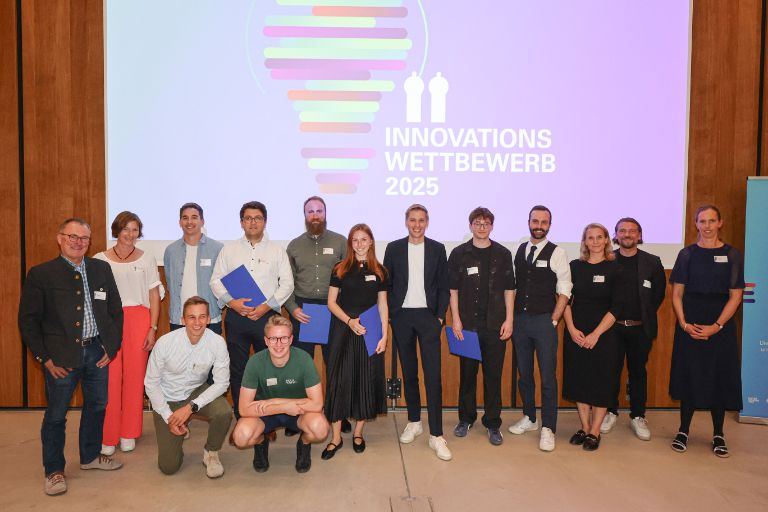
Topic: "Smart Event: digital event process"
Winner: MCube Consulting GmbH
Topic: "Online applications for humanitarian residence permits made easy"
Winner: SocialGuide
Topic: "Public Art Digital Experience'"
Winner: Atopia Space GmbH
Topic: "Munich Urban Jungle: Digitize biodiversity!"
Award winner: Hula Earth (Hula Technologies GmbH)
Topic: "Unleashing the potential of open data for Munich"
Winner: proband15 GmbH
Find out more about the projects and the 2025 award ceremony here.

The following teams won the awards in 2024:
Topic: "The cool side of Munich – finding shaded routes in pedestrian areas"
winner: SE3 Labs GmbH
Topic: "Digital welcome center – AI-supported information portal"
winner: Tür an Tür - Digitalfabrik gGmbH
Topic: "Job and recruiting compass for international newcomers"
winner: WORKINGER – Work in Germany
Topic: "Improve data on stationary traffic"
winner: Sky Eye
Topic: "Choose Green – promoting energy-sufficient mobility routines for Munich"
winner: UTurn Mobilitätswende
The following teams won the awards in 2023:
Topic: „Healthy senior citizens: "Digitalize a service and care network“, winner: Helferportal GmbH & Co. KG
Topic: „Expand places in Munich with digital innovations", winner: Team Puppet
Topic: „Digital monitoring of Munich's Diesel-free zone", winner: Transcality AG
Topic: „Text and the City - text mining in city development “, winner: Legal-Pythia LLP
More information (in German).
The following teams won the award in 2022:
- Winner of the challenge “Raising awareness of climate change”: Cityscaper GmbH
- Winner of the challenge “Development of a cemetery app”: CI Cloud Item GmbH and proband15 GmbH
- Here you can find more information on the projects and the all the award winners from 2022.
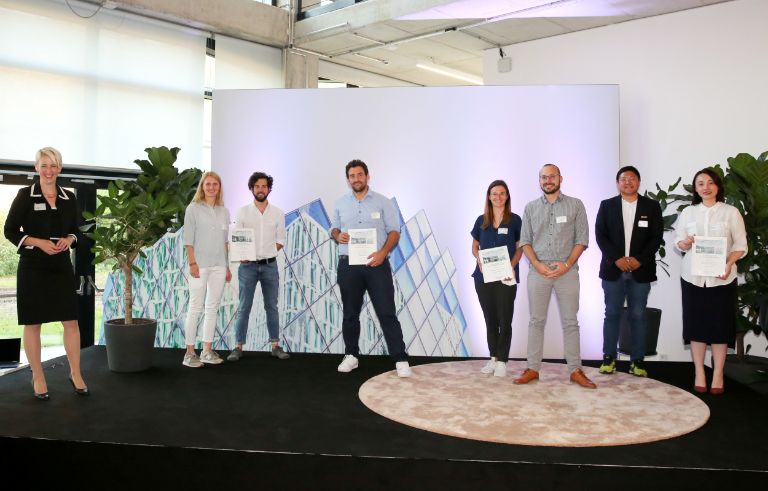
The following teams won the award in 2021:
Topic: "Pilot project for digital NO2 measurements" - Winner: Hawa Dawa GmbH
Topic: "FlexiblesArbeiten@LHM (flexible work at the City of Munich) "- Winner: klink – Digitale Services unter dem Dach der Isarwatt
Topic: "Emission-free mobility in Munich" - Winner: Plan4Better GmbH
Topic: "Improved data on stationary and moving traffic" - Winner: LiangDao GmbH
More information (in German)
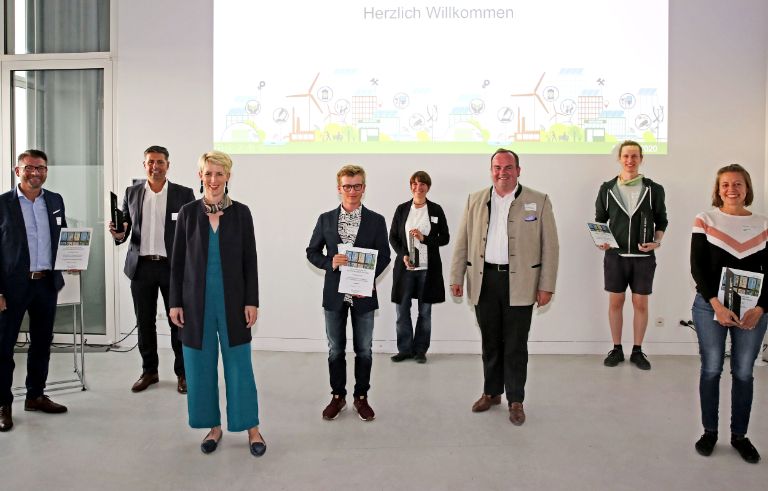
The following teams won the awards in 2020:
Topic: "Blockchain – problem-solving technology for the municipal administration?", Winner: Avaya Happiness Index
Topic: "Pre-clinic patient management using reliable preliminary assessment", Winner: medSNS
Topic: "Gamification – game-based motivation of municipal employees to adopt energy-saving behavior at work", Winner: Earth Is Sexy
Topic: "Climate Neutral Munich 2030/2035", Preisträger: Twostay
The following teams won the award in 2019:
Topic: Waste avoidance in Munich's schools, winner: upride (formerly bike|solutions )
Topic: Weekly digital market – Penetrating new target groups, winner Digitaler Wochenmarkt München
Topic: Self-generating calendar of cultural events for urban districts, winner: Neighbor
Our cooperation partners
Five entrepreneurship centers are involved in the implementation phase and offer tailored support to the award winners. Depending on specific needs and suitability, this can range from coaching or thematic workshops to participation in an entrepreneurship program. You can find information on the services on the centers’ respective websites:
Any questions? Drop us a line!
All interested parties are welcome to reach out to the respective contact persons. No central information event is planned.
We look forward to your ideas and wish you the best of luck in the Innovation Competition!
General questions about the competition:
Department of Labor and Economic Development
innovationswettbewerb.raw@muenchen.de or
Frieke Meijer-Schepman
phone: +49 89 2337 25461
f.meijer-schepman@muenchen.de
Questions about the programs and services offered by the Entrepreneurship Centers:
UnternehmerTUM
Michael Stockerl
mobile: +49 151 1062 6730
stockerl@unternehmertum.de
Strascheg Center for Entrepreneurship
Moritz Hoffmann
phone: +49 89 1265 3213
moritz.hoffmann@sce.de
LMU Innovation & Entrepreneurship Center IEC
Annie Weichselbaum
a.weichselbaum@lmu.de
Startup centre founders@unibw
Philipp Landerer
phone: +49 89 6004 4510
philipp.landerer@unibw.de
Start2 Group GmbH
Anna Keup
mobile: +49 175 4130 029
anna.keup@start2.group